
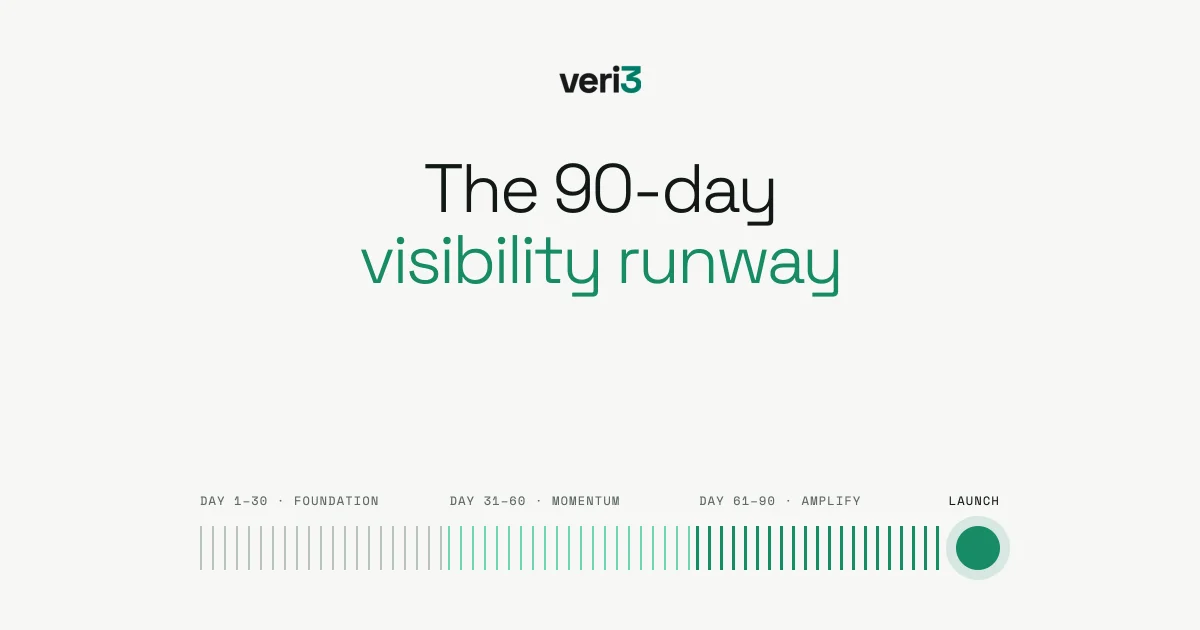
A Web3 marketing strategy should ideally begin with a four-week planning phase followed by 90 days of coordinated execution. For projects launching within 90 days, planning and execution can overlap to build visibility, establish credibility, and reach relevant audiences before launch.
Many Web3 projects spend months developing their products but begin marketing only in the final weeks. Their first major announcement must then introduce the brand, explain the product, and generate interest simultaneously.
A clear go-to-market strategy helps teams align SEO, AEO, public relations, content marketing, social media, and influencer campaigns around their launch objectives.
Key Takeaways
- Plan before investing heavily: Allow approximately four weeks for GTM research, positioning, messaging, and channel strategy.
- Adapt to your launch timeline: A 90-day pre-launch plan can work when strategy and execution overlap. Projects with more flexibility can complete planning before beginning a dedicated 90-day campaign.
- Prioritize relevance over reach: Select media outlets and influencers based on audience fit, credibility, and engagement quality rather than follower counts or traffic alone.
- Optimize continuously: Track qualified traffic, media visibility, audience engagement, and pre-launch interest to improve campaigns throughout execution.
90-Day Web3 Marketing Strategy: Timeline and Deliverables
For projects with a fixed launch date, the following accelerated roadmap combines planning and execution within 90 days.
| Timeline | Marketing Priorities | Key Deliverables |
|---|---|---|
| Days 1–15 | Audience research, competitor analysis, positioning | Audience profiles, messaging framework |
| Days 16–30 | GTM planning, website preparation, SEO, initial content | Channel strategy, content calendar, media research |
| Days 31–45 | Educational content, founder thought leadership, early audience engagement | Published articles, founder content, baseline performance data |
| Days 46–60 | PR strategy, community engagement, creator research | PR plan, creator shortlist, campaign adjustments |
| Days 61–75 | Launch communications, campaign preparation, distribution planning | Press materials, creator briefs, approved launch calendar |
| Days 76–90 | Launch activation, performance monitoring, optimization | Live campaigns, reporting dashboard, post-launch action plan |
How Much Planning Time Does a Web3 Launch Need?
A Web3 project should generally allow approximately four weeks for GTM planning, covering market research, audience segmentation, competitive positioning, messaging, channel selection, budget allocation, and campaign KPIs.
The timeline depends on the project’s readiness. A startup with clear positioning, an established audience, and a functioning website may be ready to execute campaigns sooner. A new project targeting multiple markets or institutional clients may need additional preparation.
There are two practical approaches:
For projects launching within 90 days: Planning and preparation should run alongside each other. Teams can begin technical SEO improvements, content development, and analytics setup while finalizing their GTM strategy. Major campaigns should begin once positioning, messaging, and channel priorities are agreed upon.
For projects with flexible launch timelines: Complete a four-week GTM strategy sprint before beginning a dedicated 90-day execution program. This allows more time to implement campaigns, assess early results, and optimize performance.
Why Pre-Launch Visibility Matters in a Web3 Go-to-Market Strategy
A go-to-market (GTM) strategy defines how a product reaches its intended audience and gains market traction. Pre-launch visibility supports that strategy by introducing the project to potential users, customers, and partners before its official launch.
Different Web3 projects require different approaches.
A DeFi protocol may prioritize community education, security communication, and crypto-native creators. A blockchain infrastructure provider targeting institutions may benefit more from technical content, executive thought leadership, and specialized industry publications.
A campaign attracting a smaller audience of relevant developers or institutional decision-makers may deliver greater business value than one generating thousands of impressions among people unlikely to use the product.
Phase 1: Build Your Web3 Marketing Foundation (Days 1–30)
The first month establishes the project’s positioning, messaging, and digital foundations while essential marketing activities begin.
Define your target audience and positioning
Identify your priority audiences, whether developers, institutional clients, ecosystem partners, or retail users.
Analyze competitors’ websites, media coverage, and social media activity to identify opportunities for differentiation.
Develop a clear messaging framework explaining:
- What the product does and whom it serves.
- Which problem it addresses.
- How its capabilities differ from existing alternatives.
Avoid broad claims such as revolutionizing Web3. Specific use cases and verifiable capabilities provide a stronger foundation for marketing.
Build an SEO strategy around useful content
Conduct keyword research around the problems your product solves, relevant technologies, and questions your audience is searching for.
However, avoid forcing keywords into headings and paragraphs simply to improve rankings.
A common mistake in Web3 content marketing is repeating the same search terms unnaturally throughout an article. This makes content harder to read and can undermine its usefulness.
Google’s Search Essentials recommends using relevant search terms in prominent locations, while its spam policies explicitly discourage keyword stuffing. Google also emphasizes creating helpful, people-first content.
For example, an RWA tokenization platform could publish articles explaining token issuance, asset management, and institutional use cases, incorporating relevant keywords naturally.
The priority should be answering your audience’s questions clearly, with SEO helping the right people discover those answers.
Prepare your content and media plan
Ensure your website clearly explains the product, its use cases, and how interested audiences can learn more.
Develop an editorial calendar covering educational articles, technical explainers, founder commentary, and social media content.
Research publications and journalists covering your sector. Identify potential stories based on your product’s capabilities, market relevance, and upcoming milestones.
Begin publishing foundational content and addressing urgent website improvements while finalizing the broader marketing plan.
Phase 1 milestone: Clear positioning, approved messaging, an SEO-ready website, an editorial calendar, and initial media research.
Phase 2: Build Credibility Through Content and Crypto PR (Days 31–60)
The second month focuses on building visibility among relevant audiences and evaluating early campaign results.
Establish founder thought leadership
Founders and executives often have valuable perspectives on the problems their products address.
A stablecoin infrastructure founder might discuss cross-border settlement challenges. A blockchain developer could explain interoperability or scalability limitations.
Develop these perspectives into LinkedIn posts, X threads, contributed articles, or interviews.
Effective thought leadership contributes informed perspectives to industry discussions rather than repeatedly promoting the product.
Develop a realistic crypto PR strategy
Earned media coverage generally requires a genuinely newsworthy development, such as significant funding, a major strategic partnership, a notable technical achievement, or an important industry development.
For early-stage projects without these milestones, consistently pitching product ambitions may generate limited editorial interest.
Founder commentary, educational content, relevant industry discussions, and selective paid media placements can provide alternative routes to visibility.
Paid placements should be clearly distinguished from independent editorial coverage.
Prepare media materials and build relevant relationships so the project is ready to pursue earned coverage when a compelling story emerges.
Publish educational content and engage your community
Use Web3 content marketing to explain technical concepts, address common questions, and demonstrate practical applications.
Distribute useful content through relevant social channels, founder profiles, and community discussions.
For community-focused projects, prioritize meaningful participation over membership numbers. Technical questions, product feedback, and informed discussions often provide more useful signals of interest than passive follower growth.
Review early performance data to identify which topics, channels, and messages attract relevant audiences. Use those findings to improve the next round of content and campaigns.
Phase 2 milestone: Published educational content, active founder communications, a defined PR strategy, relevant audience engagement, and initial performance insights.
Phase 3: Activate Your Web3 Marketing Campaigns (Days 61–90)
The final month coordinates launch communications while using performance data to refine campaign execution.
Prepare your launch PR campaign
Develop an announcement explaining what is launching, who it serves, and why it matters.
Support important claims with evidence and prepare relevant product information, visuals, and spokesperson details.
Choose distribution channels according to the announcement’s news value. Significant developments may justify earned media outreach, while routine launch updates may be better suited to owned channels or selective paid distribution.
Select relevant crypto influencers and media outlets
One common mistake in Web3 marketing is choosing influencers and publications primarily based on follower counts, readership, or website traffic.
A creator with 20,000 highly engaged followers in your niche may generate more qualified interest than one with 500,000 followers who rarely discusses your product category.
The same applies to media placements.
A blockchain infrastructure company targeting financial institutions may find a specialized finance or technology publication more relevant than a larger outlet reaching primarily retail traders.
Evaluate influencers and media outlets based on audience relevance, credibility, engagement quality, geographic reach, and alignment with campaign objectives.
The goal is to reach people who are likely to care about your product, rather than simply maximizing impressions.
Coordinate distribution and optimize performance
Adapt the launch announcement into formats suited to different audiences:
- PR: A newsworthy announcement or targeted media pitch.
- Website: A detailed product explanation or launch article.
- LinkedIn: Founder perspectives and industry context.
- X: Product highlights, technical updates, and community communication.
- Influencers: Educational demonstrations or product walkthroughs.
Before launch, verify website functionality, documentation, analytics, onboarding resources, and community support channels.
During campaign execution, monitor audience response, review referral traffic, and adjust content or distribution where necessary.
Prepare follow-up communications and content based on the initial campaign results.
Phase 3 milestone: Coordinated launch execution, performance reporting, campaign optimization, and a post-launch communications plan.
How to Measure Web3 Marketing Performance Before Launch
Effective Web3 digital marketing requires measuring how relevant audiences respond to campaigns, rather than tracking activity alone.
| Objective | Relevant KPIs |
|---|---|
| Brand visibility | Branded searches, relevant media mentions |
| Public relations | Earned coverage, media relevance, referral traffic |
| SEO and content | Search impressions, organic traffic, relevant rankings |
| Social media | Qualified engagement, referral clicks |
| Influencer marketing | Audience relevance, tracked traffic, campaign engagement |
| Pre-launch interest | Registrations, demo requests, developer sign-ups |
Choose metrics that reflect your business objectives.
For example, a blockchain infrastructure company targeting developers may find documentation visits and developer registrations more valuable than general social media impressions.
Establish baseline measurements early and review performance throughout the campaign. This allows teams to identify which activities deserve additional investment and which need adjustment.
Common Web3 Pre-Launch Marketing Mistakes
Even well-funded projects can weaken their launch visibility through avoidable marketing decisions.
- Starting marketing too late: Allow sufficient time for research, messaging, content development, and audience engagement.
- Prioritizing reach over relevance: Select media and creators based on audience fit rather than headline traffic or follower counts.
- Forcing keywords into content: Write naturally and satisfy search intent instead of repeatedly inserting target keywords.
- Expecting earned coverage without news value: Evaluate whether your announcement warrants independent editorial interest.
- Neglecting optimization and post-launch marketing: Track results, refine campaigns, and prepare continued communication after launch.
Frequently Asked Questions About Web3 Marketing Strategy
A comprehensive Web3 pre-launch marketing campaign may require $50,000–$150,000 for PR, content marketing, community development, and influencer partnerships. Larger campaigns involving multiple markets or major creator activations can exceed $200,000.
These are planning estimates. Actual budgets depend on the project’s audience, launch objectives, and campaign scope.
Budget allocation should reflect the target audience, product category, and launch objectives.
For example, a consumer-facing DeFi project may allocate more funding to community development and crypto influencers, while an enterprise blockchain company may prioritize industry PR, thought leadership, and educational content.
For a $100,000 marketing budget, one possible allocation is 30% to influencer campaigns, 25% to community and social media, 20% to PR, 15% to content and SEO, and 10% to testing and optimization.
This allocation is a starting point that should be adjusted according to the project’s priorities.
A four-week GTM planning phase is useful for audience research, positioning, messaging, channel selection, and budget allocation.
However, essential activities such as website improvements, foundational content, and campaign preparation can begin during this period.
For projects launching within 90 days, planning and execution should overlap. Projects with greater flexibility can complete the strategy phase before starting a dedicated 90-day execution program.
The decision depends on the project’s audience and available news.
Projects with significant funding, major partnerships, or technical milestones may benefit from earned media outreach. Consumer-facing projects may gain more initial exposure through relevant creators and community campaigns.
Institutional blockchain businesses may prioritize industry publications and founder thought leadership.
Yes. Web3 projects can build visibility through educational content, technical demonstrations, founder commentary, community engagement, and industry discussions before launching a product or token.
Marketing should focus on verifiable capabilities, development progress, and practical use cases rather than unsupported expectations.
Maintain visibility through product updates, educational content, founder commentary, community engagement, and relevant media opportunities.
Repurpose earned coverage into social content and website resources where appropriate. Track which channels attract qualified audiences and use those findings to guide future campaigns.
Reserve part of the marketing budget for continued activity after launch.

About the author
Motiur Rahman
Motiur Rahman is the Co-Founder of Veri3. Specializing in SEO, digital marketing, and data-driven growth, he helps businesses strengthen their search visibility, improve digital performance, and develop effective marketing strategies. His work at Veri3 focuses on bringing research-led marketing approaches to blockchain and emerging technology companies.
View profile and all articles